Refillable Perfume Systems: Design and Cost Decisions
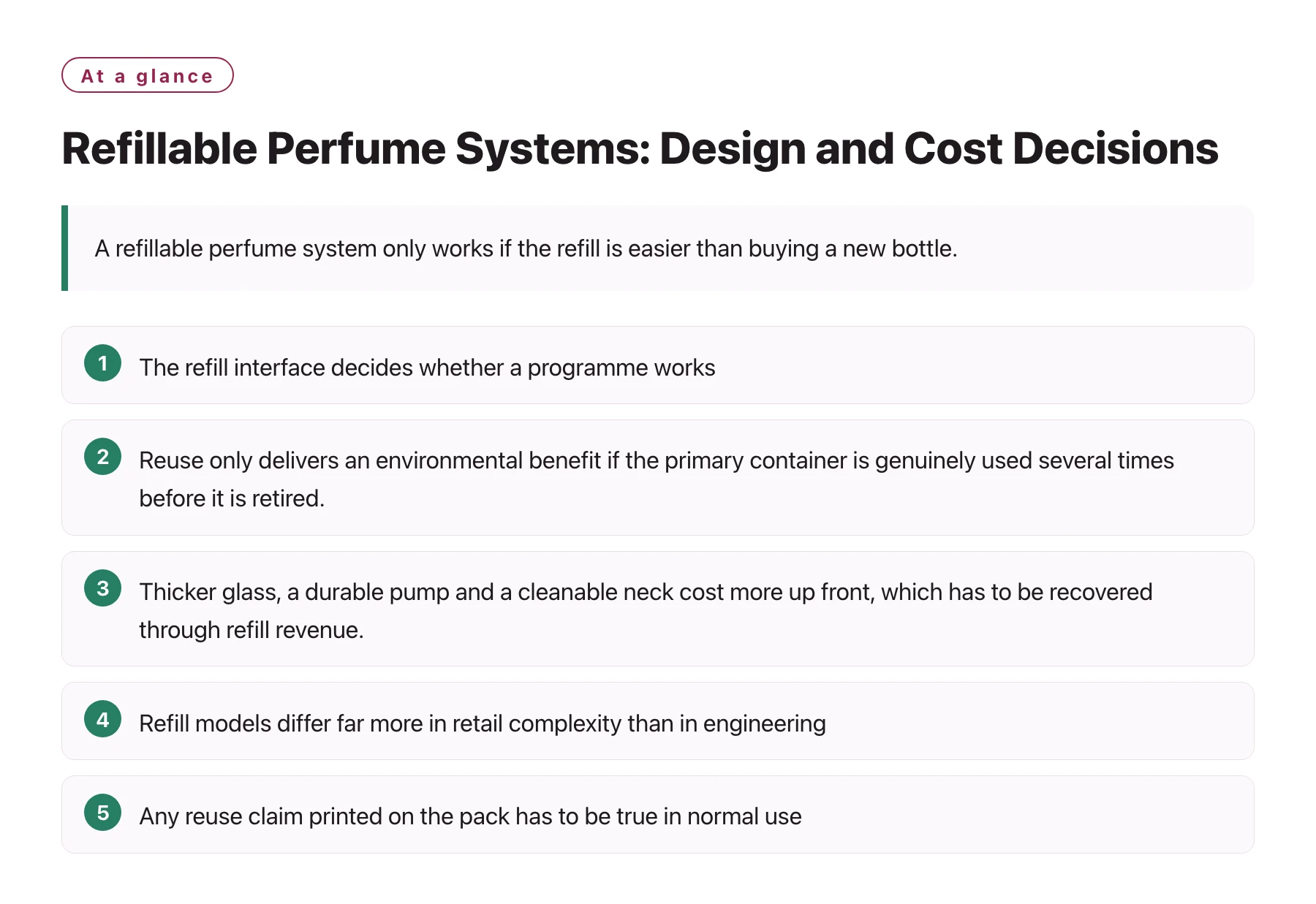
A refillable perfume system only works if the refill is easier than buying a new bottle. That sounds obvious and it eliminates most designs on the table, because it forces the interface, the bottle durability and the retail step to be solved together. Brands that treat refillability as a material choice rather than a customer behaviour usually end up with an expensive bottle that nobody refills.
Key takeaways
- The refill interface decides whether a programme works, since a top-up that spills or drips will not be repeated by customers.
- Reuse only delivers an environmental benefit if the primary container is genuinely used several times before it is retired.
- Thicker glass, a durable pump and a cleanable neck cost more up front, which has to be recovered through refill revenue.
- Refill models differ far more in retail complexity than in engineering, and the retail step is usually what fails.
- Any reuse claim printed on the pack has to be true in normal use, because unsubstantiated environmental claims attract regulatory attention.
Refillable fragrance has moved from a niche idea to a routine line item in packaging discussions, driven partly by customer expectation and partly by regulation. The appeal is easy to state: sell the bottle once, sell the contents repeatedly, and use less material per unit sold.
The difficulty is that a refill programme is not a bottle with a removable cap. It is a system that involves the packaging, the point of sale, the price ladder and the customer's kitchen table, and the weakest of those four decides the outcome.
This guide sets out the decisions in the order that avoids rework, starting with the refill interface and ending with the claims on the carton.
Six decisions that shape a refill programme
- Pick the refill model firstDecide between a pouch, a cartridge, a concentrate or an in-store station before any bottle design work begins.
- Design the interface around a clumsy userAssume the customer is refilling over a light-coloured surface with no funnel and limited patience.
- Specify the bottle for repeated useGlass thickness, neck threads and pump durability all have to survive more than one filling cycle.
- Set the price ladder deliberatelyThe first purchase carries the container, so the refill price has to look clearly cheaper without eroding margin.
- Work out the retail stepDecide whether refills ship direct, sit on shelf beside the bottle, or require staff involvement in store.
- Decide what happens at end of lifePlan how the bottle is finally retired, and whether any part of it can be collected or replaced.
The refill interface is the whole product
Everything a customer experiences in a refill programme happens in about thirty seconds at a sink or a dressing table. If those thirty seconds are messy, the programme is over regardless of how good the scent is.
That is why the interface deserves more engineering attention than the bottle silhouette, even though the silhouette is what sells the first unit.
Refilling has to be cleaner than replacing
A pouch that requires steady pouring into a narrow neck will be used once and then avoided. A cartridge that clicks into a fixed seat, or a bottle with a wide neck and a shaped funnel, removes the failure mode instead of instructing the customer to avoid it.
Test the refill with real people before approving tooling. Two minutes of observation at a kitchen table is more informative than any specification sheet.
Bottle life is a glass and pump decision
A container built for one filling is not automatically fit for five. Repeated handling wears the neck threads, the pump collar and any decorative coating, and a bottle that looks tired after the second refill undermines the premise of the programme.
Thicker glass, a serviceable pump and a neck design that can be wiped clean all raise the unit cost of the primary pack, which is exactly the cost the refill revenue is meant to recover.
Hygiene matters more than customers expect
Refilling introduces air, hands and whatever was in the bottle before. A design that keeps the product stream enclosed, and that allows the neck to be cleaned between fills, avoids the slow accumulation of residues that changes how the perfume smells over time.
The quiet failure mode of refill programmes is a bottle so well made that customers never buy a second one, paired with a refill so inconvenient that they never buy that either. Both halves have to be tested on real people at the same time. A manufacturer that runs bottle design and filling together, as Xuelei does, can prototype the refill interface and the filling line compatibility in one loop, which shortens the distance between a drawing and a container that actually works.
Refill models and what each one demands
| Refill model | How the customer tops up | Where it fits well | What it costs the brand |
|---|---|---|---|
| Pouch or bottle refill | Pours the contents into the original bottle | Simple lines with a loyal repeat customer | Leak-proof packaging and clear filling instructions |
| Cartridge or insert | Swaps a sealed inner unit into a permanent case | Premium lines where the case is part of the identity | Precision tooling and tight component tolerances |
| Concentrate plus carrier | Dilutes a small concentrate at home | Light shipping and low material use | A behavioural ask that many customers decline |
| In-store refill station | Fills the bottle at a counter or machine | Retail partners with staff and space | Equipment, training and hygiene procedures |
| Travel top-up vial | Refills a small atomiser from the main bottle | Gift sets and travel formats | Extra components without much material saved |
The fourth column is where most programmes are underestimated. Refillability shifts cost from materials into operations, and operations do not shrink when volumes grow, so the model has to be chosen for the business the brand actually runs rather than for the packaging concept.
Rules and claims that constrain the design
Refillable packaging sits in the middle of a policy conversation about how much material a product uses over its life, and that conversation is moving faster than most packaging cycles.
The practical consequence is that the design, the claim and the evidence need to be decided together.
Packaging rules increasingly reward reuse
European work on packaging waste and the Packaging and Packaging Waste Regulation has shifted attention from what a pack is made of toward how many times it is used and how much material it consumes across its life [1]. For a refill programme, that direction is supportive, provided the reuse actually happens and can be described accurately.
The same policy direction affects reporting obligations and fee structures in several markets, which is one reason to keep a clear record of how much material each refill saves against a single-use equivalent.
Reuse guidance exists, and it is detailed
Industry initiatives such as the Sustainable Packaging Coalition publish guidance on reuse systems and material selection, covering questions that marketing copy tends to skip, such as cleaning, return rates and the number of cycles a container should be designed for [2].
Reading that material before tooling is committed is cheaper than reading it after, because the answers often change the neck design or the closure rather than the label.
A refill still has to be safe through its life
The chemicals agenda covers a product from production through use to disposal, including how containers are managed after they are emptied [3]. For fragrance that means thinking about residues, cleaning and what a customer does with a partly used refill.
Manufacturers such as Guangzhou Xuelei that handle bottle and packaging design alongside filling can usually answer these questions during development, because the same team is responsible for how the unit behaves on a line and in a hand.
Sources
- European Commission: Packaging Waste and the PPWR —— EU rules on packaging and packaging waste, including the Packaging and Packaging Waste Regulation requirements on recyclability and design.
- Sustainable Packaging Coalition —— A membership organisation working on more sustainable packaging design, publishing material and recyclability guidance.
- UNEP: Chemicals and Pollution Action —— The UN Environment Programme's pages on chemicals management, including the sound management of chemicals in products.
Frequently asked questions
Is refillable perfume actually better for the environment?
It can be, but only if the primary container is reused enough times to offset the extra material and energy in making it. That depends on bottle durability and on how convenient refilling is. A heavy bottle that is refilled once may compare poorly with a light single-use pack.
What is the hardest part of a refill system to get right?
The interface between the refill and the bottle. If topping up is messy, slow or requires a funnel, customers stop doing it and the programme dies quietly. Test the refill with real people before committing to tooling, since observation reveals problems that drawings do not.
Should the refill cost less than the original bottle?
Clearly less, or the incentive disappears, because the first purchase already includes the container. The gap has to be wide enough for customers to notice while still covering the cost of the refill pack, the filling operation and any retail handling involved in selling it.
Can we claim a perfume is refillable on the packaging?
You can, provided the claim is accurate in normal use and you can support it with evidence. Reuse and environmental claims face increasing scrutiny, so keep records of how the refill works, how many times the container is designed to be reused, and what material the refill saves.
Does a refill programme need a different bottle?
Usually yes. Repeated filling puts more stress on the neck threads, the pump and any surface decoration, so the container needs a serviceable closure and a design that can be wiped clean. A standard single-use bottle often works once and then looks worn.